A Guide to the Ngezi Forest Reserve
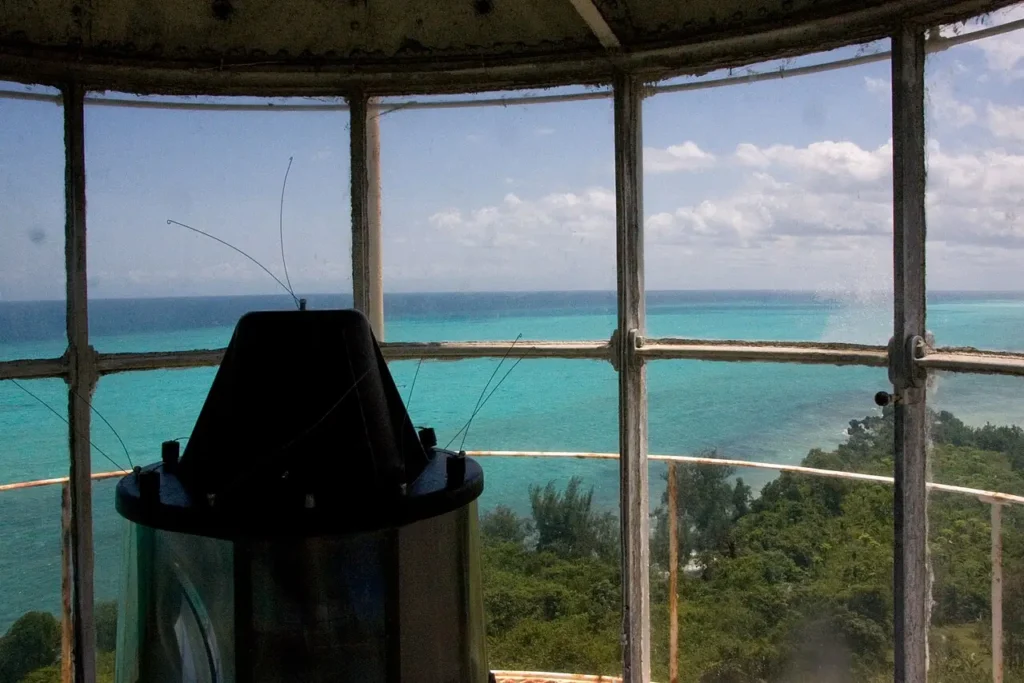
Perched on the edge of the Ras Kigomasha Peninsula near the Village of Makangale in northern Pemba lies the Ngezi Forest Reserve, a rare remnant of the indigenous high canopy forest that once blanketed the entire Zanzibar archipelago. Unlike the palm fringed coastlines typically associated with the Indian Ocean, Ngezi Forest offers a prehistoric landscape where giant trees canopies in several layers reach toward the sky and tangled lianas weave through the undergrowth. For the traveler seeking a deeper connection and a traditional eco experience on Pemba, Ngezi Forest, stretching across more than 2,000 hectares provides a profound sense of tranquility and a glimpse into a world that has remained largely unchanged for centuries.
This guide explores the rich tapestry of Ngezi, from its ancient roots to its current status as a vital biodiversity hotspot. We will delve into the history of this protected woodland, introduce you to its rare residents, including the Pemba Scops Owl and the recently documented Pemba blue duiker, and examine the dedicated conservation efforts that keep this ecosystem thriving. Whether you are a dedicated naturalist or a traveler seeking the cooling shade of the canopy, Ngezi is an essential stop for any visitor to Pemba Island.
- Location: North Pemba, Micheweni District (Near Konde & Makangale Village)
- Ticket Entry & Ranger Fees: $10 Conservation fee required at check-in (supports local forest guards)
- Guide Policy: Mandatory certified forest ranger required for all interior hikes
- Top Highlights: Endemic birdwatching, tracking the rare Pemba blue duiker, and hiking trails in the forest
- Where to Stay: No lodges inside the forest but there are lodges of international standard in the nearby Village of Makangale
History & Community Conservation in Action
Ngezi Forest is the last remaining primary forest in Zanzibar, standing as a living relic of the vast tropical woodlands that once dominated the region. While much of the surrounding land was cleared over the centuries for clove and coconut plantations as well as farming, Ngezi Forest was spared, largely due to its rugged terrain and the local community’s respect for the forest’s spiritual and practical resources. It represents a bridge to Pemba’s ecological past, offering a contrast to the managed farmland and rolling landscapes found elsewhere on the island.
The reserve was formally established in 1998 to protect this fragile ecosystem from the pressures of logging and agricultural expansion. Today, it is managed as a protected area where conservation and education go hand in hand, allowing visitors to appreciate the forest’s complexity without disturbing its delicate balance. Its status as a protected woodland is not merely a legal designation but a commitment to preserving the biological heritage of the Swahili Coast.
Historically, the forest has also held deep cultural significance for the people of North Pemba, serving as a source of traditional medicines and a site for spiritual reflection. This heritage adds a layer of depth to the visitor experience as you aren’t just walking through a collection of trees, but through a landscape that has been intertwined with Swahili life and local lore for generations. This connection between the community and the canopy is what has ultimately allowed Ngezi to survive into the modern era.
Conservation in Action in Ngezi Forest
The preservation of Ngezi’s biodiversity is a sophisticated, collaborative effort led by the Zanzibar government’s Department of Forestry (MANREC) in close partnership with international and local NGOs. This collaboration represents a modern approach to conservation where scientific research, government policy, and community involvement intersect. By moving beyond simple protection to active habitat management and scientific documentation, these guardians ensure that the forest remains a resilient fortress for Pemba’s most vulnerable species.
A cornerstone of this effort is the work conducted by the Italy based conservation group Istituto Oikos. Their recent camera-trap studies, supported by the Critical Ecosystem Partnership Fund (CEPF) and the European Union, have been instrumental in providing the first photographic evidence of the elusive Pemba blue duiker in over two decades. This research doesn’t just document the existence of a recently thought extinct species, it provides the scientific leverage needed to protect the forest from invasive infrastructure and illegal logging. Further support from foundations such as Audemars-Watkins and Fondation Franklinia has allowed for the implementation of comprehensive management plans that balance tourism with strict environmental safeguards.
Recently, the Ngezi Forest Heritage Organization has attempted to organize the efforts of conservation into one single strong organization. The organization also does alot of the ground work and monitoring on the ground and have a network of local guardians who help out with monitoring and research in and around Ngezi Forest.
On the ground, these partnerships translate into tangible protection. Increased funding has facilitated the hiring and training of extra forest guards, many of whom are recruited from local villages, ensuring that those who live nearest to the forest have a direct stake in its survival. Specialized protection is focused on high-pressure areas like the Tondooni Peninsula, where guards monitor for illegal trapping and woodcutting. This community-inclusive model ensures that when you visit Ngezi, your presence supports a network of professionals and locals dedicated to maintaining the “Green Island’s” primary heart.
Rare & Endemic Wildlife of Ngezi Forest
Ngezi is a stronghold for rare mammals, some of which are only now being documented by modern science through non-invasive technology for the first time.
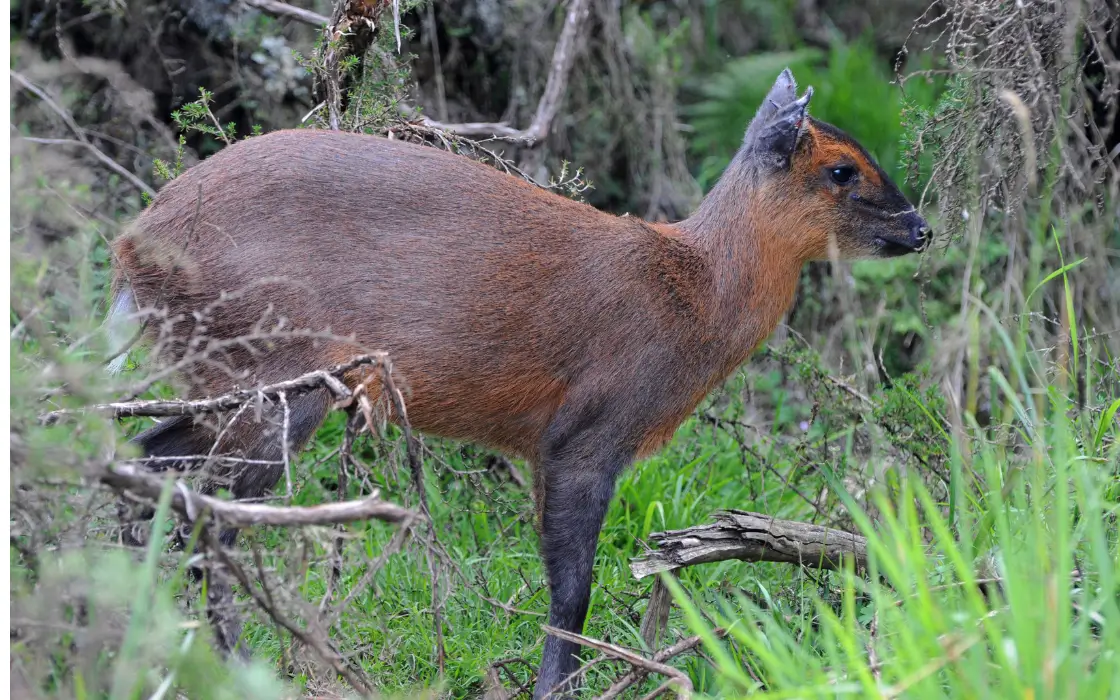
- The Pemba Blue Duiker (Philantomba monticola): Standing just 30 centimeters (12 inches) high at the shoulder, this tiny antelope is a master of the undergrowth. The antelope was until recently though to be extinct.Recent camera traps confirmed that these duikers are well-distributed across the reserve. Their presence serves as a vital indicator of a healthy, intact ecosystem.
- The Pemba Flying Fox: You are highly likely to encounter this giant fruit bat, which boasts a wingspan of up to 1.6 meters. These magnificent creatures are often seen roosting in large, noisy colonies during the day, a sight unique to the island’s primary forests.
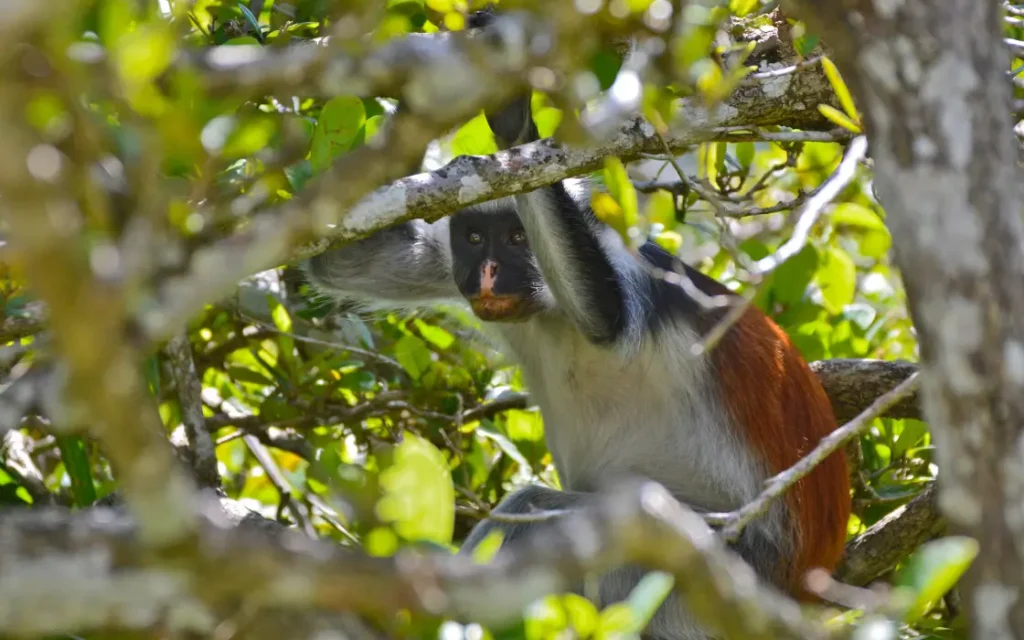
- Primates: Keep a quiet watch for vervet monkeys and blue monkeys, who leap through the branches of ancient mahogany and ironwood trees.
Conservation Breakthrough
Recent camera-trap studies funded by the European Union and CEPF provided the first photographic proof in over two decades that the elusive Pemba blue duiker is actively breeding within Ngezi.
Birding in Ngezi Forest
Ngezi is a true pilgrimage site for birdwatchers, hosting several species found nowhere else on Earth. There are currently 4 endemic bird species found in Ngezi forest marking it a unique and critical eco system well worth a visit. To see these species, cooler early mornings and late afternoons are optimal, when the forest is most vocal. Pemba Scops Owl is a nocturnal species most active at night. Guided walks are highly recommended for locating these specialized species, including night walks for nocturnal residents.
Key Endemic Birds of Ngezi Forest:
- Pemba Scops Owl (Otus pembaensis): A tiny, nocturnal owl with striking amber eyes. A guided night walk is essential for hearing its haunting call and spotting it by torchlight.
- Pemba Green Pigeon (Treron pembaensis): A vibrant forest bird frequently spotted high in the canopy feeding on wild fruits.
- Pemba Sunbird (Cinnyris pembaeensis): A small, active bird with iridescent plumage, often seen darting through the forest edges.
- Pemba White-eye (Zosterops vaughani): A social, greenish bird commonly seen in active flocks, distinguished by a prominent white ring around its eye.
Other Notable Birds:
While many visitors to Ngezi Forest want to see the endemic birds, there are around 160 bird species found on Pemba. Notable species apart from the endemic to look out for is Mangrove Kingfisher along the forest’s edge and the Brown-headed Parrot, another special inhabitant of this northern wilderness.
How to Visit Ngezi Forest
To protect this fragile ecosystem, access to the interior of Ngezi is carefully managed. All visitors must adhere to the following protocols to ensure their presence supports the forest’s preservation. Visitors are required to check in at the park office found along the main road to the east of the forest on the Konde side or at The Ngezi Forest Interpretation Center located closer to Vumawimbi Beach near the village of Makangale. The interpretation Center serves as the administrative hub where visitors check in and receive an essential orientation regarding the forest’s history and ecological significance. It is managed by the Department of Forestry (MANREC), which oversees the delicate balance between tourism and habitat protection.
Before entering the forest trails, all visitors must check in at one of two official administrative stations run by MANREC.
Mandatory Guide Requirement: To ensure safety and ecological integrity, all hikes must be accompanied by a certified forest ranger or guide. These guides are highly experienced in identifying medicinal plants, tracking animal sounds, and navigating the smaller trails of the forest.
Eastern Park Office: Located along the main access road coming from Konde.
Ngezi Forest Interpretation Center: Located near Makangale village on the road toward Vumawimbi Beach.
At check-in, you will pay your conservation fee and be assigned a mandatory certified ranger. Conservation fees are critical, as they directly fund conservation efforts, including the hiring of forest guards who protect vulnerable species from illegal activities. Fees change regularly, for the latest fees, check at the park office or the interpretation center.
Best Time to Visit
Dry Season (June to October): Offers firm, dry trails ideal for trekking and general forest walks.
Short Rains (November to December): The forest turns a deep emerald green, sparking high activity among bird species and offering ideal conditions for photography and birding.
Responsible Travel Tips
Support the Network
Your entry fees and the hiring of local guides contribute directly to the conservation funding that pays for forest guards and scientific research.
Respect the Silence
Keep noise levels to a minimum to avoid disturbing sensitive species like the Scops Owl or the shy blue duiker.
Stay on the Path
To prevent soil erosion and protect delicate ground flora, always stick to the designated trails.
Zero Waste
Ensure nothing is left behind; Ngezi holds many "undescribed" species that rely on a pristine habitat.
Ngezi Forest Reserve FAQs
Do I need a guide to explore Ngezi Forest Reserve?
Yes, hiring a certified forest ranger at the park office or interpretation center is mandatory for all interior trails. Rangers ensure visitor safety, protect fragile ground flora, and excel at spotting camouflaged wildlife like the Pemba Scops Owl and blue duiker.
Can I combine a visit to Ngezi Forest with other places in North Pemba?
Absolutely! Due to its northern location, a morning hike in Ngezi pairs seamlessly with an afternoon swim at nearby Vumawimbi Beach, a visit to the Ras Kigomasha Lighthouse, or a stop at the Kidike Flying Fox Sanctuary.
What should I wear and bring for a hike in Ngezi?
Wear lightweight long pants, sturdy walking shoes or boots, and insect repellent. Bring a reusable water bottle, binoculars for birdwatching, and cash in Tanzanian Shillings or USD for entry fees and ranger tips.